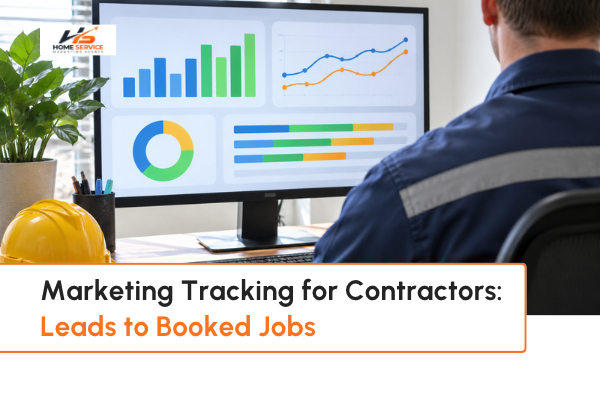
Marketing Tracking for Contractors: Leads to Booked Jobs
For home service contractors, every marketing dollar has to earn its keep. You might be running Google Ads, testing Facebook ads, and working on local SEO all at once. But if you can't say which of those brought in the calls that turned into paid jobs, you're making budget decisions on gut feel. Marketing tracking for contractors fixes that by connecting what you spend to what you actually book.
This guide explains what to track, how to set it up, how to think about cost per lead and return on investment, and why one shared dashboard beats a pile of spreadsheets. It's written for owners and office managers of home service companies. Tracking doesn't create leads by itself, and results depend on your market, budget, and follow-up, but it shows you where your money is working and where it isn't.
Why Marketing Tracking for Contractors Goes Beyond Clicks?
IMAGE — SECTION 1 — DO NOT PASTE ChatGPT image prompt (copy and paste): Create a realistic, landscape 16:9 photograph. A smartphone face-up on a truck dashboard showing a blurred incoming call screen with no readable text, a clipboard of job tickets on the passenger seat, sunlight through the windshield. No people. Style: clean, professional, bright, realistic home-service photography. Do not include any text, words, letters, logos, or numbers anywhere in the image. No faces visible and no identifiable people. Filename: real-time-marketing-tracking-contractors-leads-booked-jobs-2.jpg Alt text: |

Most ad platforms are happy to report clicks, impressions, and "engagement." Those numbers tell you people saw your ad. They don't tell you whether anyone called, whether the caller was in your service area, or whether the job was worth doing.
Here's a simple illustration. Imagine two campaigns. Campaign A produces 50 leads, but most are out of area, price shoppers, or wrong-service calls, and only a handful book. Campaign B produces 15 leads, and most of them are qualified leads in your area that turn into profitable jobs. On a clicks-and-leads report, Campaign A looks like the winner. On a booked-jobs report, Campaign B is clearly better. These numbers are hypothetical, but the pattern is common: volume and value aren't the same thing.
That's the whole case for tracking further down the funnel. The goal isn't more data. It's better decisions about where to spend. Good tracking also protects you from cutting the wrong channel: a campaign that looks expensive per click may be your best source of booked work, while a cheap one may mostly bring calls you can't use.
How Do Contractors Track Where Their Leads Come From?

Lead source tracking means tagging every call, form, and message with where it came from: Google Ads, Facebook ads, your Google Business Profile, organic search, referrals, or something else. A few tools make that possible:
Google Business Profile performance. Google's Business Profile performance page shows calls from the profile's call button, messages, bookings, direction requests, website clicks, and the searches people used to find you.
Google Ads conversion tracking. Google Ads can measure calls from ads, calls to a number on your website, and clicks on a phone number on your mobile site, alongside form submissions.
Campaign tags on links. For links you place in emails, social posts, or partner sites, Google Analytics uses campaign URL parameters such as utm_source, utm_medium, and utm_campaign so visits show up under the right source. (These belong on your ad and email links, not on the blog posts you publish.)
Facebook lead ads tracking. Meta's lead ads documentation explains that leads from Facebook lead forms can be sent straight into a CRM, so each one arrives already tagged with its source.
Call tracking for home service businesses. Dedicated tracking numbers for each channel let you see which ad, page, or mailer made the phone ring. Test every number before you trust the report, and follow applicable call-recording and privacy rules.
The simplest habit matters too: when someone calls, ask "How did you hear about us?" and record the answer the same way every time. Software catches most sources; your team catches the rest.
Cost Per Lead and Qualified Leads

Cost per lead is simple math: what you spent on a channel divided by the number of leads it produced in the same period. It's useful, but only if you also look at quality.
What is a good cost per lead for contractors?
There isn't a single honest answer. We haven't found a reliable public benchmark, and the figures that circulate online often come from companies selling ads or leads. A "good" cost per lead depends on your trade, your market, the size of your average job, and how many leads you book. A higher cost per lead can be perfectly fine for large replacement or remodel work, while it would be a problem for small repair calls.
A more useful number is cost per qualified lead, and better still, cost per booked job. Decide what "qualified" means for your business (in your area, for a service you offer, with a realistic timeline), then count only those. Compare channels on that basis and the picture often changes.
Want help connecting your ad spend to real booked jobs? Book a Strategy Call with Home Service Marketing Agency, or call 949-850-8868. |
Track Booked Jobs, Not Just Leads

To track booked jobs, every lead needs to move through the same stages in one place, for example: new lead, contacted, estimate scheduled, estimate given, won, lost. When a lead becomes a job, its original source stays attached. That's what lets you say "Google Ads brought us 12 jobs last month" instead of "Google Ads brought us a lot of calls."
Some ad platforms can learn from this data too. Google's article on importing offline conversions explains that offline conversion tracking helps lead generation advertisers see which leads become paying customers, using first-party data already in a CRM. Meta's documentation notes that CRM data about lead quality can be shared back through its Conversions API. In plain terms, you can show the ad platforms which leads were worth something, not just which leads filled out a form.
Two cautions. First, this only works if your team updates job status consistently; a CRM full of leads marked "new" forever tells you nothing. Second, connections between platforms need to be configured and tested carefully, with customer data handled securely.
How Do You Measure Marketing ROI for a Home Service Business?

Marketing ROI for contractors compares what you spent with what that spending brought back. A practical way to measure it:
Total marketing cost for a channel over a set period, including ad spend and any management fees.
Booked jobs and recorded revenue from leads tagged to that channel in the same period.
Gross profit on those jobs, if you track it, since revenue alone can flatter low-margin work.
Return = (gross profit from those jobs − marketing cost) ÷ marketing cost.
Keep a few things in mind. Big jobs can take weeks to close, so look at a few months, not a few days. Repeat customers and referrals from a first job add value that a single-month view misses. And if the revenue data is incomplete, say so in the report rather than guessing. An honest estimate with known gaps is more useful than a confident number built on assumptions.
One Contractor Marketing Dashboard Instead of Scattered Spreadsheets

When ad data lives in one place, calls in another, and jobs in a spreadsheet, nobody sees the whole picture. A contractor marketing dashboard pulls the key numbers together: leads by source, cost per lead, response times, appointments, booked jobs, and revenue where it's recorded.
Calls and form submissions can appear in a CRM as they arrive, which is where "real-time" tracking is most useful: your team can see a new lead and respond quickly. Job and revenue numbers update when your team records them, so the dashboard is only as current as your follow-up. CRM reporting for contractors works best with a short weekly look at new leads and response times, and a monthly review of cost per booked job by channel.
Conversion tracking for contractors isn't a one-time setup. Ad platforms change, phone numbers get reused, and forms get edited. Test your tracking every few months by placing a test call and submitting a test form, and confirm both show up with the right source.
Keep the dashboard simple enough that you'll actually use it. Five or six numbers you look at every week beat fifty you never open. A good starting set: new leads by source, percentage of calls answered, average time to first response, estimates scheduled, jobs won, and cost per booked job. If one of those numbers moves sharply, that's your cue to dig in, whether it's a campaign that stopped working, a phone line that isn't being answered, or a form that broke after a website update.
Stop guessing and start making decisions with data.
Your marketing should do more than generate traffic. It should help you win more of the jobs you want. Marketing tracking for contractors makes that possible: tag every lead with its source, judge channels by qualified leads and booked jobs, measure return over a sensible time frame, and review it all in one place.
Home Service Marketing Agency focuses on qualified lead generation, conversion tracking, and clear performance reporting, combining targeted advertising, conversion-focused websites, CRM integration, and follow-up automation that's configured and tested for each client. See our services, read our post on Google Ads for home service companies, check out our guide to local SEO for contractors, or browse the Home Service Marketing blog at homeservicemarketingagency.com.
Ready to get found, get the call, and get booked?
Book a Strategy Call with Home Service Marketing Agency, call 949-850-8868, or email [email protected].
This article is for general information only and is not a substitute for a marketing strategy tailored to your business, or for legal or financial advice. Results from SEO, Google Ads, and other marketing depend on your market, budget, competition, response time, and sales process, and are not guaranteed. Contact Home Service Marketing Agency at 949-850-8868 or [email protected] for a proposal specific to your business.